The Outerwear Edit

Coats & jackets that make the outfit

Why Your Coat Sleeves Never Fit Right Once a Sweater Goes Underneath

2026-07-24

Quick Answer: Coat sleeves feel tight over a sweater because you tried the coat on over a t-shirt. A bulky knit adds real volume at the upper arm and shoulder — the exact places a thin-layer fit check never tested. Bring the bulkiest sweater you actually wear to the fitting room, put it on, and check that you can reach forward and cross your arms with it underneath.

The coat fit beautifully in the shop. You were sure about it.

Then the first genuinely cold day arrives, you put a sweater on underneath, and suddenly you can’t reach for a door handle without the shoulders binding. Nothing about the coat changed. What changed is that you finally used it for its actual purpose.

Why Your Coat Sleeves Never Fit Right Once a Sweater Goes Underneath

At a glance

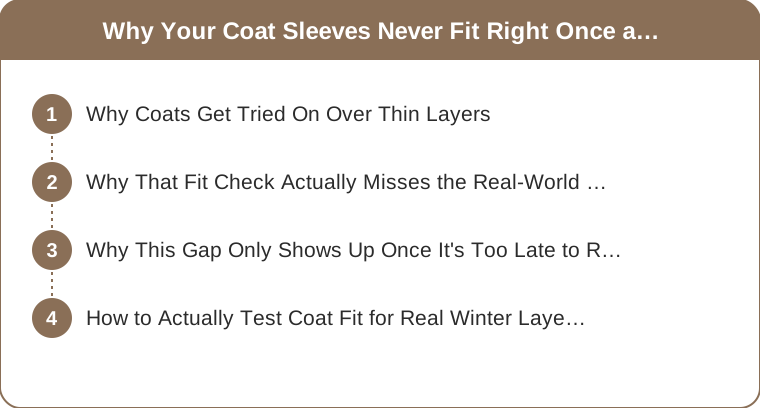
Why Do Coat Sleeves Feel Tight Over a Sweater?

Because a knit layer adds volume exactly where a coat has the least spare room: the upper arm and the shoulder.

A mid-weight sweater can add a meaningful amount of circumference around the bicep, and a chunky cable knit adds considerably more. That’s not a lot in absolute terms — but a tailored coat sleeve is cut with very little ease at the upper arm, so it’s easily enough to turn “moves freely” into “binds when I reach.”

The shoulder is worse. A coat’s armhole position is fixed. Add bulk underneath and the sleeve head effectively sits lower and tighter, which restricts your whole arm rather than just your bicep. That’s why the tightness often feels like it’s coming from the shoulder even though the sweater is on your arm.

And it compounds down the sleeve. Bulk at the upper arm pulls the whole sleeve up, which is why the same coat that hit your wrist over a t-shirt now sits an inch short over a sweater.

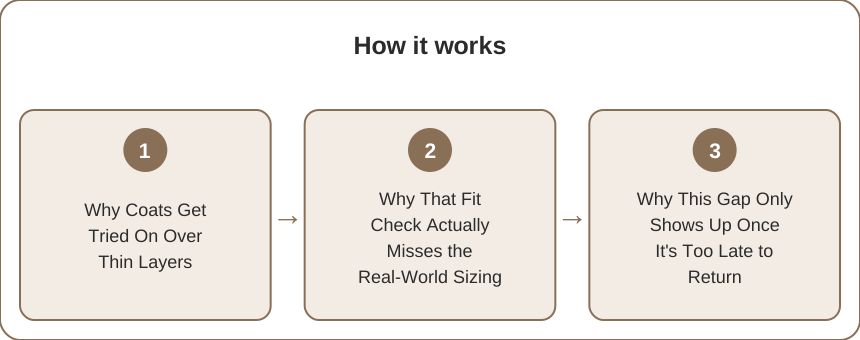
Why Doesn’t the Fitting Room Catch This?

Because you try coats on over whatever you happen to be wearing — and in a shop, that’s almost always something thin.

It’s a completely reasonable default. Nobody thinks to carry a bulky sweater to a coat-shopping trip, and shops are heated, so you’re generally in a t-shirt or a light top when you walk in.

The result is a fit test conducted under conditions that don’t match a single day of the coat’s actual use. A winter coat’s entire job happens over a sweater. Testing it over a t-shirt is testing the wrong scenario.

The timing makes it worse. The gap doesn’t reveal itself in the shop — the coat genuinely feels comfortable, which builds real confidence in the purchase. It reveals itself weeks later on the first cold day, usually well past the return window, and often after the tags are off and the coat has been worn.

Why Your Coat Sleeves Never Fit Right Once a Sweater Goes Underneath

How Do You Test a Coat for Real Winter Layering?

Wear the bulkiest sweater you’ll actually wear underneath, to the shop. That’s the whole fix, and it costs nothing.

The full check, with the sweater on:

  1. Reach straight forward with both arms, as if opening a door. The shoulders shouldn’t bind and the back shouldn’t pull.
  2. Cross your arms. This is the harshest test and the one that catches a too-narrow back.
  3. Reach up as if grabbing something off a shelf. Some ride-up is normal; being unable to complete the motion isn’t.
  4. Check the cuff. With arms down, the sleeve should reach your wrist bone. Over a sweater it’ll sit shorter than it did over a tee — that’s the measurement that matters.
  5. Button or zip it fully and repeat steps 1 and 2. A coat that only moves when open isn’t a winter coat.
  6. Check across the shoulders and upper back, not just the arms. Horizontal pulling there means you need the next size.

If your realistic winter wardrobe includes both thin layers and heavy knits, size for the heavy one. A coat with a little room over a t-shirt looks relaxed. A coat that’s tight over a sweater is unwearable.

How it works

5 Mistakes Everyone Makes Buying Winter Coats

  1. Trying it on over a t-shirt. The central problem, and the one that causes the other four to go unnoticed.
  2. Judging fit standing still with arms down. Almost any coat fits in that position. The fit only fails in motion.
  3. Buying online without a layering test. If you must, order the size up as well, and try both over your actual sweater before removing any tags.
  4. Assuming a coat can be let out. Sleeves and shoulders are the hardest parts of a garment to alter, and most coats have no seam allowance to work with. Shortening sleeves is easy; adding room usually isn’t.
  5. Ignoring the shoulder because the sleeve feels fine. Bulk pulls at the shoulder seam first, and a shoulder that’s too tight restricts everything below it. Check across the back before you check the arm.

FAQ

Should you size up in a winter coat?

Size for the bulkiest layer you’ll genuinely wear underneath — which often means one size up from your usual, but not always. Try both sizes over a real sweater rather than assuming; some coats are already cut with layering room built in.

How much room should a coat have in the sleeves?

Enough to reach forward and cross your arms with a sweater on, without binding at the shoulder or pulling across the back. With arms down, the cuff should still reach your wrist bone over that layer.

Can a tailor fix tight coat sleeves?

Rarely in a satisfying way. Shortening sleeves is straightforward, but adding width at the upper arm or shoulder requires seam allowance that most coats don’t have, and reworking a sleeve head is expensive. Getting the size right in the shop is far cheaper than fixing it later.

TL;DR

  • A sweater adds bulk at the upper arm and shoulder — exactly where a coat has the least ease.
  • Bulk also pulls the sleeve up, so the cuff sits shorter than it did over a tee.
  • Fitting rooms are heated, so you test in a thin layer and never test the real scenario.
  • The gap shows up after the return window, on the first cold day.
  • Bring your bulkiest sweater to the shop. Reach forward, cross your arms, reach up — buttoned.
  • Sleeves and shoulders can’t easily be let out. Get it right the first time.

Keep Reading

This article is for general styling and informational purposes only. Trends, sizing, availability and pricing may vary by brand and season.

why do coat sleeves feel tight over a sweatercoat sleeve fit with layers guidehow to buy a coat that fits over sweaters

← All articles